Method
From today’s sky to one colour.
Prism is not a horoscope written for everyone born under one sign. It calculates from your own chart, every morning, and shows how. Here is exactly what happens.
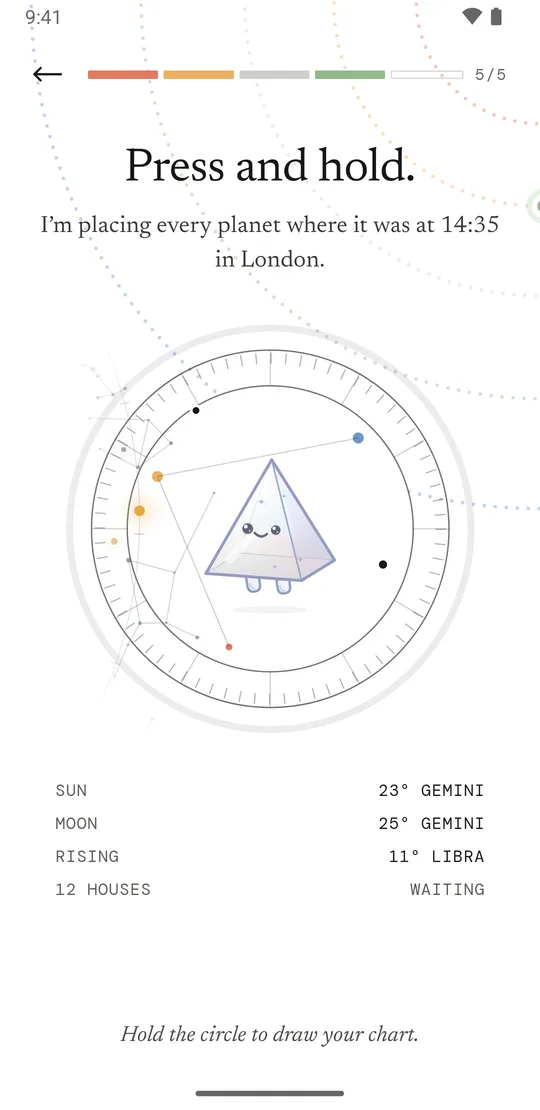
Your chart, from date, time and place
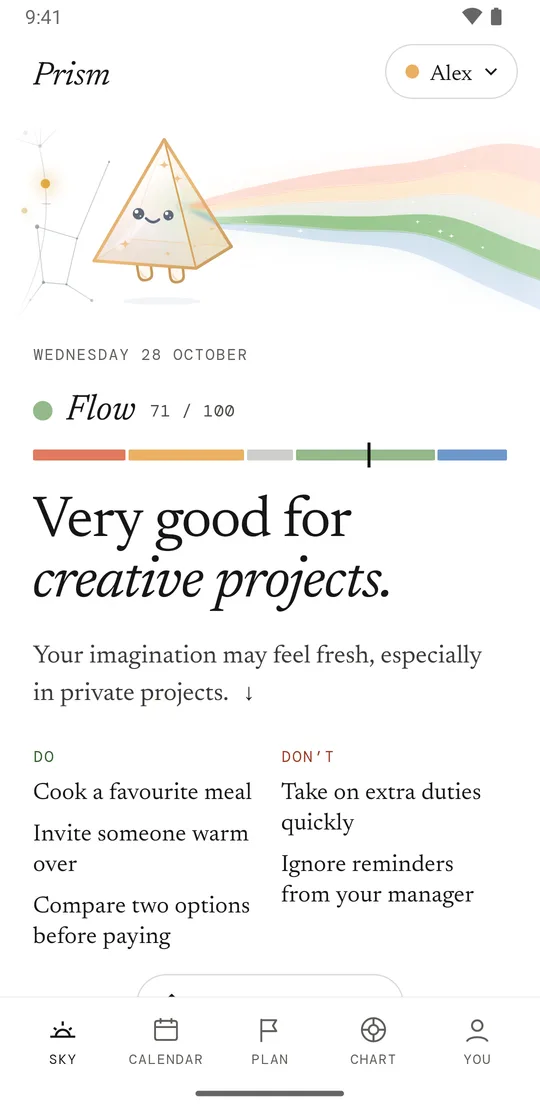
Today, in one colour
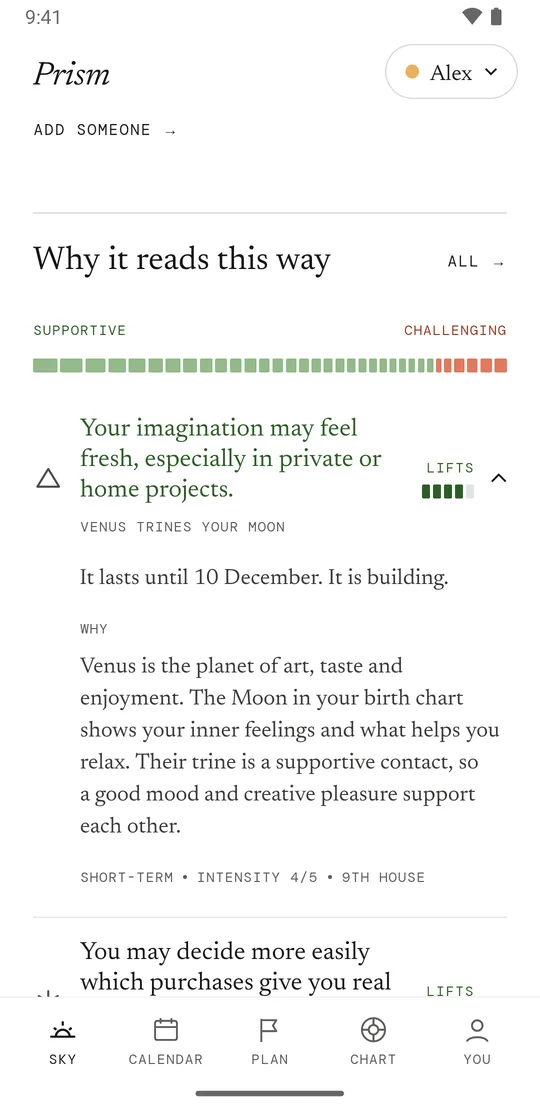
The transits behind it
- 01
Your chart, calculated once
From your birth date, time and place, we calculate where the Sun, Moon and planets were. We also calculate your rising sign, your Midheaven (the top point of the chart) and the lunar nodes. We use the tropical zodiac and Placidus houses. The positions come from the Swiss Ephemeris, a standard set of astronomical tables. Without a birth time, we use noon. Then the Moon may be a few degrees wrong, and the rising sign and houses are only approximate.
- 02
Today’s sky, compared with it
Every morning, Prism places today’s planets on your chart. It finds every aspect (a meaningful angle) they make to your birth planets and to the main points of your chart. It also finds which of your houses each planet is passing through.
- 03
Each event weighed
An aspect counts more when it is close to exact. The allowed distance from exact is called the orb. An aspect also counts more when it involves your Sun, Moon or rising sign. Each planet counts differently. For example, a trine from Venus helps, and a square from Saturn makes things harder. The slow outer planets count for less, so they do not hide what happens on the day.
- 04
One score, each event counted once
The day’s score adds up each event exactly once. It counts transits to your planets, transits to the main points of your chart, and planets moving through your houses. Nothing is counted twice. So a strong Mars day shows clearly in the score.
- 05
Adjusted to your chart
Some charts have many strong days, and some have few. So Prism compares each score with your own days. It uses a fixed sample of 274 days from 2025 to 2027, and then gives the five colours. Your best days are Harmony and your hardest days are Hard, whatever your chart is like.
- 06
The reasons, shown
Every colour comes with its reasons: the transits behind it, ranked by how much each one changed your day. Together they make the colour you see. Nothing is hidden.
Calibration
How often each colour comes up
Over a year, each person gets roughly these shares. Flow is the most common day. Hard is rare on purpose.
- Hard≈ 7%
- Tense≈ 23%
- Steady≈ 14%
- Flow≈ 43%
- Harmony≈ 13%
Steady, leaning flow · leaning tense
Plan
The best day for something specific
Plan answers “when should I…?” for 35 plans, from signing a contract to a first date. Each plan has a significator. This is the planet that tradition links to the plan. For example, Mercury is for documents and Venus is for love and money. Mars is for anything that needs force, Jupiter for growth and Saturn for things that must last. Each plan also has houses: the areas of life where it happens.
A day scores well for a plan when its planet gets good support in your chart, and the transits fall in the right houses. This is how Plan separates a first date (Venus and your 5th house) from meeting new people (your 11th house). A few strict rules also apply. Plan never suggests contracts, loans, big purchases or publishing while Mercury is retrograde.
The result is a short list: the best periods, the days to avoid, and the reasons. See Plan’s screens for six example plans.
What we don’t claim
Reflection, not prediction
Prism does not predict events. It is not medical, legal, financial or psychological advice. A colour describes how your day may feel. It does not decide what happens. If a reading makes you feel worse, close the app and trust yourself.
Privacy
Your chart is yours
We use birth details only to calculate your chart. They never go into analytics, and we never sell them. You can export or delete everything from the app at any time. Read the privacy policy.
Questions
Is astrology scientifically proven?
No. There is no scientific evidence that planets affect personality or events, and we do not claim it. Prism uses astrology to help you think about your days and your timing. It helps you notice your days. It does not predict them.
How accurate are the positions?
Very accurate. The app calculates positions with the Swiss Ephemeris, the standard in astrology software. This website uses astronomy-engine. Both agree to within a small fraction of a degree. That is much more precise than astrology needs.
Why might my day be Hard when nothing bad happens?
A Hard day means more difficult influences than usual for you. It does not mean that something bad will happen. Many people use Hard days for quiet work, patience and rest.
Do I need my birth time?
It helps. Without it, Prism uses noon. Every planet is still correct to within about one degree, and the Moon to within about seven. But the rising sign and houses are only approximate. These are what make two people born on the same day different.
Where does my birth data go?
We store your birth details to calculate your chart and forecasts. We never sell them and never send them to analytics. You can export or delete everything from the app. The birth chart calculator on this website works in your browser and never sends your birth details. The birthplace search sends only the place name you type to GeoNames, to suggest towns.